
You are here

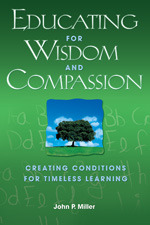
Educating for Wisdom and Compassion
Share
Share

Educating for Wisdom and Compassion
Creating Conditions for Timeless Learning

  • John P. Miller - Ontario Institute for Studies in Education, Centre for Teacher Development


July 2005 | 184 pages | Corwin
"A clearly written, concise, and inspired book…"
-Lourdes Arguelles
Professor of Education and Cultural Studies
Claremont Graduate University

Blending philosophy, research, and three decades of practice, the author offers an engaging discussion of essential principles of timeless learning, including attention, contemplation, connection, participation, responsibility, wholeness, and joy. Educators in today's schools can apply these principles, models, and methods to inform instruction in their own classrooms and teaching practices. Some of the benefits timeless learning can bring include:
  • Helping students develop deep joy, wholeness, awe and wonder, and a sense of purpose
  • Improving attention, alertness, perception, and memory
  • Using meditation and contemplation to help reduce stress, anxiety, heart rate, and blood pressure

 
Part I Timeless Learning: Definitions and Fundamentals
 
1. Timeless Learning
What Is Timeless Learning?

 
What Are the Characteristics of Timeless Learning?

 
Holistic/Integrative

 
Embodied

 
Connected

 
Soulful

 
Transformative

 
Flow

 
Participatory

 
Non-dualistic

 
Mysterious and unexplainable

 
Immeasurable

 
What Does Timeless Learning Bring to Today's Classrooms?

 
Conclusion

 
References


2. The Perennial Philosophy: A Relaxed Universalism
Foundations of the Perennial Philosophy

 
The interconnected nature of reality and the mysterious unity of the universe

 
The intimate connection between the individual's inner self, or soul, and the mysterious unity

 
Wisdom or knowledge of the mysterious unity can be developed through various contemplative practices

 
Values are derived from seeing and realizing the interconnectedness of reality

 
Awareness of the mysterious unity of existence leads to social action to counter injustice and human suffering

 
References


Part II Timeless Learning: Processes and Practices
 
3. Letting Go and Becoming Empty
Psychosynthesis and Dis-identification

 
David Hunt

 
Krishnamurti

 
The Bhagavad Gita and Non-Attachment

 
Spiritual Knowing

 
Just Let Go

 
References


4. Attention and Meditation
Meditation

 
Forms of Meditation

 
Intellectual Meditation

 
Emotional Meditation

 
Physical Meditation

 
Action Meditation

 
Meditation Practices

 
Insight

 
Body Scan

 
Mantra

 
Visualization

 
Movement meditation

 
Getting Started

 
Meditation With Children

 
Just One Minute by Naomi Baer

 
References


5. Compassion, Caring, and Lovingkindness
Kindness, Empathy, Compassion, and Love

 
Lovingkindness Practice

 
Caring in Schools

 
School with Forest and Meadow (Ojiya School)

 
Service Learning

 
Engaged Service

 
Community-Based Work

 
To Be and to Have

 
References


6. Contemplation, Mindfulness, and Presence
Mindfulness

 
Presence

 
Contemplation and Mindfulness in Classrooms

 
Contemplation and Action

 
References


Part III Timeless Learning: Perspectives, Examples, and Outcomes
 
7. Educational Perspectives on Timeless Learning
Transcendental Education

 
Emerson

 
Thoreau

 
Bronson Alcott

 
Holistic Education

 
Linear Thinking and Intuition

 
Relationship Between Mind and Body

 
Subject Connections

 
Community Connections

 
Earth Connections

 
Self Connections

 
Slow Education

 
Conclusion

 
References


8. Examples of Timeless Learning
Krishnamurti Schools

 
Principles of Learning

 
The School

 
The Teacher

 
Waldorf Education

 
Steiner's View of Development

 
Rhythm

 
Montessori Education

 
Conclusion

 
References


9. Creating Conditions for Timeless Learning in Public Schools
Work on Yourself

 
Be Fully Present

 
Recognize the Importance of the Nonverbal

 
Honor Silence

 
Develop a Rhythm

 
Integrate Timeless Learning with other Forms of Learning

 
Balancing Spontenaity and Planning

 
Don't Forget the Body

 
Live Your Own Truth

 
Acknowledge the Mystery

 
Let Your Humanity Come Through

 
References


10. The Fruits of Timeless Learning
The Present Educational Context

 
The Results of Timeless Learning

 
Research on Contemplative Practices

 
My Own Research

 
Nature of Mediation Practice

 
Personal Effects of Meditation Practice

 
Professional Effects of Meditation Practice

 
Profiles

 
Ultimate Outcomes of Timeless Learning

 
Wisdom and Compassion

 
Joy: The Singing Soul

 
Awe and Wonder

 
Wholeness

 
Sense of Purpose

 
References


Bibliography
 
Index
Key features
  • Readable, accessible, and inspirational, in the tradition of Rachel Kessler's The Soul of Education, Steven Glazer's The Heart of Learning, and Parker Palmer's The Courage to Teach
  • An antidote to high-stakes schooling, reminding teachers, teacher educators, and school leaders that principles of learning include attention, contemplation, connection, transformation, mystery, responsibility, wholeness, and joy.
  • Ideal for workshops and courses on emotional intelligence, spirituality in education, philosophy of education, and foundations

Sample Materials & Chapters

Chapter 1: Timeless Learning


Purchasing options

For large school/district orders, volume discounts, availability and shipping times contact customer service at 800-233-9936
or order@corwin.com.

contact corwin

Please select a format:

ISBN: 9781412917049
$39.95
ISBN: 9781412917032
$79.95

For large school/district orders, volume discounts, availability and shipping times contact customer service at 800-233-9936
or order@corwin.com.