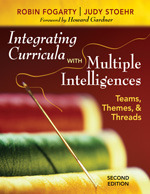

Integrating Curricula With Multiple Intelligences
Teams, Themes, and Threads
- Robin J. Fogarty - Robin Fogarty & Associates, Ltd.
- Judy Stoehr
Foreword by Howard Gardner
"The authors are sensitive to the constraints that operate on teachers even as they are open to ways in which teachers can refashion their classes and curricula to reach more children in more effective ways. This book will help teachers enliven and enrich their classrooms and forge new connections across concepts and curricula."
—From the Foreword by Howard Gardner
"On the one hand, teachers and other curriculum workers are held accountable for understanding, organizing, implementing, and designing instruction and assessing standards-based outcomes. On the other hand, they are also being admonished to teach for understanding, thinking skills, enduring learning, cooperative learning, multiple intelligences, individual differences, and developmental levels. This book provides a wealth of delightful, creative, and compelling strategies, lessons, and techniques for making sense of these many diverse theories."
—Arthur L. Costa, Professor Emeritus
California State University, Sacramento
Develop powerful instructional tools that target diverse learning needs!
In this unique and practical book, authors Robin Fogarty and Judy Stoehr demonstrate an approach for creating integrated curricula that develop higher-order thinking, mindful decision making, and productive problem-solving skills in all students. This second edition provides planning methods for interactive lessons and strategies for implementing "big ideas" or themes. Offering voices from academia and the classroom, this research-based volume:
- Provides strategies for building collaborative teacher teams
- Presents a six-step process for developing thematic learning units
- Highlights ways to thread life skills throughout the curriculum
- Describes types of assessments for integrated curricula
This insightful handbook emphasizes a learner-centered, interdisciplinary approach and holistic, experiential learning that leads to lifelong skills and equal opportunities for all children to succeed.
"Teachers are held accountable for designing instruction and assessing standards-based outcomes. They are also asked to teach for retention, cooperative learning, and individual differences. This book provides a wealth of delightful, creative, and compelling strategies and lessons, with techniques for integrating these diverse objectives."
"Has great merit in providing connections and a strong learning environment for students. The authors provide excellent charts, templates, graphic organizers, and resources for educators to use and examine."
"In this concrete book with a multitude of examples, the authors offer specific suggestions for merging curriculum with recent multiple intelligences experience and research. The tone is upbeat and the style is practical and well organized, making it appealing to teachers."
"Well written, user-friendly, and has great examples that educators will relate to."
"Clear, concise, and with outstanding illustrative material. The book adds to the discussion on integrating curriculum with multiple intelligences."
"The authors are sensitive to the constraints that operate on teachers even as they are open to ways in which teachers can refashion their classes and curricula to reach more children in more effective ways. This book will help teachers to enliven and enrich their classrooms and to forge new connections across concepts and curricula."