
You are here

Assessing Student Understanding in Science
Share
Share

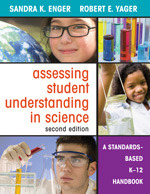
Assessing Student Understanding in Science
A Standards-Based K-12 Handbook

Second Edition


October 2009 | 216 pages | Corwin

"In this second edition, Enger and Yager expand their previous work by suggesting new assessments and more clearly connecting their assessments with the National Science Education Standards. For classroom teachers, this book offers a range of suggestions that can enhance instruction. For science teacher educators, this book is an invaluable and handy resource in working with beginning, new, or experienced science teachers."
—Julie A. Luft, Professor of Science Education
Arizona State University

Create and customize assessments to determine student understanding in six domains of science!

Carefully designed assessments can give teachers the information they need to improve instruction and help students meet educational goals and objectives. This updated resource offers a multifaceted approach to measure what students know and can do as a result of their learning experiences.

Assessing Student Understanding in Science provides educators with essential methods to best assess student proficiency and performance in science. The authors provide an extensive collection of strategies and examples for elementary, middle, and high school classrooms. Aligned with national science standards, the book includes:

  • Criteria to measure student progress in six critical domains of science—concepts, processes, applications, attitude, creativity, and the nature of science
  • Strategies to evaluate your teaching practice, such as action research, video recordings, and journaling
  • Information about using formative assessments to inform teaching
  • Methods for assessing student work using portfolios, self-evaluations, and rubrics
  • An introduction to using science notebooks as assessment tools

With the proven frameworks in this book, teachers can build customized assessments to meet instructional needs and prepare students to succeed in science.


Preface
 
Acknowledgments
 
About the Authors
 
1. A Framework for Assessing Student Understanding in Science
Assessment Based on Six Domains of Science

 
I. Conceptual Domain

 
II. Process Domain

 
III. Application Domain

 
IV. Attitude Domain

 
V. Creativity Domain

 
VI. Nature of Science Domain

 
Assessment Approaches Aligned With the Six Domains


2. Assessment in the Contexts of Teaching
Planning Instruction and Assessment

 
What Assessment Is

 
Formative and Summative Assessment

 
Assessment Types and Approaches

 
National Science Education Assessment Standards

 
Implementing Assessment Guidelines

 
The Internet as an Assessment Resource


3. Evaluating Teaching Practice
Action Research

 
Assessment of Classroom Practice With Video Recording Support

 
Sources of Instrumentation for Assessing Practice

 
Self-Assessment of Constructivist Practice

 
Science-as-Inquiry Surveys


4. Rubrics and Scoring Guides
Rubrics and Scoring Guides: What Are They?

 
Rubric Construction: A Teacher's Perspective

 
Rubric or Scoring Guide Design

 
Examples of Tasks and Rubrics

 
How Well Does a Rubric Communicate the Original Task?


5. Science Notebooks
Science Notebooks: Formative and Summative Assessment Tools

 
Notebook Scaffolds

 
Assessment Components for Notebooks

 
Supporting Graphing Skills and Abilities


6. Assessment Examples for All Grade Levels
Open-Ended Questions (Integrates Domains)

 
Student Laboratory Environment Inventory (Integrates Domains)

 
Ideas for Assessing in the Application Domain

 
Observation Checklist (Integrates Domains)

 
Use of Application-Level Multiple-Choice Questions

 
Examples for the Creativity Domain

 
Assessing Attitudes, Preferences, and Processes


7. Assessment Examples for Grades K Through 4
Applying Process Skills and Experimental Design

 
Application Assessment Items for Grades K Through 3

 
Assessing Attitudes About Science

 
Student Self-Assessment

 
Assessing Perceptions About Scientists


8. Assessment Examples for Grades 5 Through 8
Developing a Group Performance Task

 
Preparation for Standardized Tests

 
Electronic Portfolios for Students

 
Structuring Peer Assessment for Cooperative Groups

 
Class Assessment of Group Project Presentations


9. Assessment Examples for Grades 9 Through 12
Using the Student Laboratory Environment Inventory

 
Looking at Science Processes

 
Assessing Specific Areas of Understanding

 
Assessing Students' Views of the Scientific Process


Glossary of Assessment-Related Terminology
 
References
 
Index

Purchasing options

For large school/district orders, volume discounts, availability and shipping times contact customer service at 800-233-9936
or order@corwin.com.

contact corwin

Please select a format:

ISBN: 9781412969932
$42.95
ISBN: 9781412969925
$94.95

For large school/district orders, volume discounts, availability and shipping times contact customer service at 800-233-9936
or order@corwin.com.