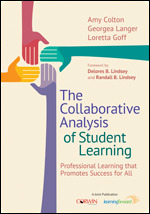

The Collaborative Analysis of Student Learning
Professional Learning that Promotes Success for All
A proven approach to transformative professional learning that raises achievement for all students!
Does professional learning at your school promote teacher growth and propel student achievement? If you’re ready for a change, turn to trusted educators Colton, Langer, and Goff, pioneers of an extraordinarily effective design for professional learning: Collaborative Analysis of Student Learning (CASL).
You’ll find complete strategies, resources and more in this evidence-based book that addresses the Common Core State Standards. Learn how to:
- Benefit from the lessons learned by the authors over two decades of nationwide implementation as you design a sustainable CASL program that drives positive change at your school
- Inquire into student work and assessments to promote learning excellence for all
- Use the CASL Teacher as Collaborative Inquirer framework to promote culturally competent, academically rigorous teaching
- Develop and implement new instructional strategies that mesh with Common Core standards
Discover how to put CASL in place at your school, helping faculty – and students – to reach their full potential.
“This book is extraordinary and a must have for every practitioner striving to improve student learning! Colton, Langer, and Goff provide explicit guidance on building a culture of collaborative inquiry to empower teachers and leaders to explore their own practices in a way that fosters meaningful and relevant learning for students.”
Victoria Duff, Coordinator of Professional Learning
New Jersey Principal and Supervisors Association
“Teacher collaborative professional learning leads to improved teaching and student learning when it is skillfully orchestrated. In this book, Colton, Langer, and Goff provide an essential resource rich with strategies, tactics, tools, and examples to guide both facilitators and team members to structure collaborative inquiry, analysis, and learning in ways that deepen their learning and practice and increase results for all students."
Joellen Killion, Senior Advisor
Learning Forward
"Teacher collaborative professional learning leads to improved teaching and student learning when it is skillfully orchestrated. In this book, Colton, Langer, and Goff provide an essential resource rich with strategies, tactics, tools, and examples to guide both facilitators and team members to structure collaborative inquiry, analysis, and learning in ways that deepen their learning and practice and increase results for all students."
"Research has shown for many years that the isolation of teachers is one of the biggest obstacles to improving teacher effectiveness. This book provides practical insights and recommendations on how teachers can work together to increase their impact on student learning. For educators seeking strategies for improving teaching and learning, this important new book will be an invaluable resource."