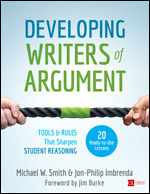


Developing Writers of Argument
Tools and Rules That Sharpen Student Reasoning
- Michael W. Smith - Temple University, USA
- Jon-Philip Imbrenda - University of Pittsburgh
Foreword by Jim Burke
Corwin Literacy
The ability to make effective arguments is not only necessary in students’ academic lives, it’s a transferable skill that’s essential to students’ future success as critical thinkers and contributing members of society.
But in the here and now, how do we engage students and ensure they understand argument writing’s fundamental components? How do we take them from “Here’s what I think” to “Here’s what I
This stunning, full-color book by Michael Smith and Jon-Philip Imbrenda shows the way, with ready-to-implement lessons that make argument writing topical and relevant. Students are first asked to form arguments about subjects that matter to them, and then to reflect on the structure of those arguments, a process that provides learners with valuable, reusable structural models.
- Throughout the book, the authors provide helpful instructional tools, including
- Literary, nonfiction, and author-created simulated texts that inspire different points of view
- Essential questions to create a context that rewards argumentation
- Lessons introducing students to the three essential elements of an argument—claim, data, and warrant—and how to make each effective
- Questioning probes, semantic differential scales, and other innovative instructional approaches
- Samples of writing from the authors’ own students, and enlightening details on how this work informed the authors’ subsequent teaching approach
Complete with guidance on applying the lessons’ techniques in a broader, unit-wide context, Developing Writers of Argument offers a practical approach for instructing students in this crucial aspect of their lifelong development.
Free resources

Lesson: Who Is the Better Superhero?
Use this lesson from Developing Writers of Argument to give students a chance to practice developing an argument of their own and defending it effectively in a debate.
“Smith and Imbrenda care about deep and meaningful learning. In this book, they show how argument can be taught in ways that develop tremendous engagement and deep understanding through a process that is in service of critical literacy and social imagination and responsibility. There are a lot of books about argument out there. I’d argue that this one is the best and most transformative I’ve ever read. The ‘so what’ lessons on reasoning/warranting alone will transform your teaching of argument and of much else.”
“I was impressed with how Smith and Imbrenda's approach helped students who are usually passive learners become so engaged in discussions about readings. Our test scores reflected that passion.”
“In just a few weeks, Smith and Imbrenda's approach to instruction transformed my classroom. My students and I became passionate about our reading, writing, and discussions; our state assessment scores went up. This stuff works. I wish I had known about it my whole career.”
“Developing Writers of Argument is not only a practical guide for teaching students, but also a practical guide for educating teachers in the art of argument made simple. Instead of throwing the baby out with the bathwater, the authors draw upon years of research-based strategies and methodologies to make lessons real and relevant for today’s learner. Reading the lessons provided me that 'ah ha' moment and helped me to internalize the need for the three Rs (relevance, responsibility, and respect) in teaching and learning.”