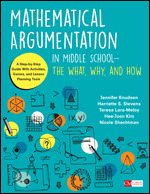


Mathematical Argumentation in Middle School-The What, Why, and How
A Step-by-Step Guide With Activities, Games, and Lesson Planning Tools
- Jennifer Knudsen - SRI International, USA
- Harriette S. Stevens - Mathematics Education Group
- Teresa Lara-Meloy - SRI International, USA
- Hee-Joon Kim - SRI International, USA
- Nicole Shechtman - SRI International, USA
Corwin Mathematics Series
Get them talking: Your formula for bringing math concepts to life!
Want your middle schoolers to intelligently engage with mathematical ideas? Ready to help them construct and critique viable arguments that meet tough Standards for Mathematical Practice 3 standards? Look no further. This research-based gem will help you foster the critical reasoning and argumentation skills every student needs for intelligent discourse within our modern society. Learn how to bring mathematical argumentation alive in your classroom—all within a thoroughly explained four-part model that covers generating cases, conjecturing, justifying, and concluding.
Filled with content-focused and classroom-ready games, activities, vignettes, sample tasks, and links to online tools and a rich companion website, this innovative guide will help you
- Immediately engage students in fun, classroom-ready argumentation activities
- Plan lessons that foster lively, content-driven, viable argumentation
- Help students explore mathematical ideas and take ownership of their learning
- Facilitate deep mathematical understanding
- Promote students’ precise use of mathematical language to construct, justify, and critique mathematical ideas and mathematical statements or the arguments of others.
- Encourage logical, clear connections between abstract ideas for enhanced 21st century skills
This guide delivers all the tools you need to get serious about mathematical argumentation and bring well-planned, well-constructed mathematical discourse to life in your classroom today!
Free resources

Activity: Zip, Zap, Zop
"Zip, Zap, Zop" is a classic simple warm-up game, featured in Mathematical Argumentation in Middle School, that helps students understand that it is OK to make mistakes, speak so that everyone can hear, and pay close attention to one another.

Improv Games to Engage Students in Mathematical Discussions
"In our work, we help teachers support rich, inclusive mathematical discussions among all students. For these discussions to happen, a classroom culture must be developed based on what are often new norms for mathematics class: that students should listen to each other, not just the teacher; that mistakes are OK, even welcomed, as students search for mathematical truth together. New norms take time and deliberate effort to develop."
Read more from Jennifer Knudsen, author of Mathematical Argumentation in Middle School-The What, Why, and How, on Corwin Connect.
Establishing Norms for Mathematical Argumentation
"In the past, and even many classrooms today, a math class involved the teacher presenting a lesson, then students practicing the procedures therein, and the teacher correcting students along the way. But things are changing!"
Read more from Teresa Lara-Meloy, author of Mathematical Argumentation in Middle School-The What, Why, and How, on Corwin Connect.