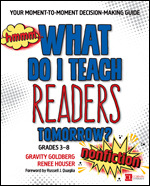


What Do I Teach Readers Tomorrow? Nonfiction, Grades 3-8
Your Moment-to-Moment Decision-Making Guide
Foreword by Russell J. Quaglia
Corwin Literacy
“Well, that was a great minilesson—now what?”
For every teacher who has uttered those words, this book is for you. In What Do I Teach Readers Tomorrow? Nonfiction, educators Gravity Goldberg and Renee Houser take the guesswork out of determining students’ needs with a moment-to-moment guide focused on the decisions that make the biggest impact on readers’ skill development. With the authors’ guidance, you put their next-step resources into action, including:
- Tips for what to look for and listen for in reading notebook entries and conversations about books
- Reproducible Clipboard Notes pages that help you decide whether to reinforce a current type of thinking, teach a new type of thinking, or apply a current type of thinking to a new text
- More than 30 lessons on synthesizing information and understanding perspectives, writing about reading, organizing thinking, and more
- Reading notebook entries and sample classroom conversations to use as benchmarks
- Strategies for deepening the three most prevalent types of thinking students do when synthesizing: Right-Now Thinking (on the page), Over-Time Thinking (across a picture book, a chapter, or longer text), or Refining Thinking (nuanced connections across text and life concepts)
- Strategies for deepening the three most useful types of thinking—feelings, frames, and opinions—when considering perspectives
- Online video clips of Renee and Gravity teaching, conferring, and “thin slicing” what nonfiction readers need next
With What Do I Teach Readers Tomorrow? Nonfiction, you learn to trust your instincts and trust your students to provide you with information about the next steps that make the most sense for them. Teaching students to engage with and understand nonfiction becomes personal, purposeful, and a homegrown process that you can replicate from year to year and student to student.
“Goldberg and Houser – both former staff developers at the Teachers College Reading and Writing Project – have perfectly combined theory and practice to help teachers put students first in their decision-making process. Best of all, they’ve provided the tools necessary to assist teachers in making those decisions become a reality right away.”— Reviewed by Pam Hamilton for MiddleWeb
Free resources
Create an Inspiration Wall to Uplift All Students
Much like the adage “a rising tide lifts all boats,” displaying students’ writing about reading gives all students the opportunity to learn from—and aspire to— the ways of thinking of peers. Check out this activity from What Do I Teach Readers Tomorrow? Nonfiction, Grades 3-8 to learn how to create an effective inspiration wall for your classroom.
"We know of no resource that promotes responsive teaching as well as these books do. Goldberg and Houser like teaching to improve, and then describe how teachers can learn to be fully in the moment of instructional decision making by focusing on a handful of things. From the detailed lessons to boxes titled, 'Decide to teach this tomorrow if your students . . .' these authors anticipate the content teachers want and the questions they raise. These thoughtful books show teachers how to make children’s reading needs central to instructional planning."
"I love this series! Goldberg and Houser succeed at something difficult: freeze-framing their intentional decisions about teaching readers in a way that we can all “see”—and then do in our own classrooms. They provide a decision-making model that helps teachers feel confident in letting their own observations of students’ written and spoken responses to text guide them. They distill the ever-present what-do-I-teach-next question into three choices, and these choices all center on furthering students’ ways of thinking as they read fiction and nonfiction. Through classroom videos and notebook entries, we learn the authors’ intuitive process. They don’t just leave us pondering, but scaffold our ability to be responsive teachers by providing lesson ideas that work for every kind of tomorrow—every reading next step. For fiction, they share lessons on character and theme; for nonfiction, on synthesizing information and understanding perspectives. The bonus is this: when we study and reflect on the authors’ decision-making process, we enhance and improve our own. These books should become seminal works."
"Making decisions about reading in our classroom is not easy, even though we make hundreds every day. Often, we don’t give much thought to how we decide what we do, but with this book, we are taken on a guided tour of what it means to make super-intuitive decisions about what our readers need next. Each chapter addresses decisions about key aspects of building a literature-rich environment and a community of readers, including reading notebooks, teaching students how to synthesize ideas, and understanding perspective. The chapters on great nonfiction and fiction texts and on helping readers learn how to select involving books are favorites, as they give me a more focused method to rely on. The books are practical, friendly, and chockfull of ideas and lessons that can be readily implemented."
"These books exemplify the intersection of excellent scholarship and practical application for teachers in the field. They beautifully illustrate those essential metacognitive processes in a progression, and this helps teachers see how instructional decisions become instructional moves that translate into high cognitive demand learning experiences for students. This series an invaluable teaching tool for those who want to implement authentic Balanced Literacy experiences for their students."
"Goldberg and Houser offer an insider’s view of intentional decision making in action by making us front-row observers of their thinking process. We stand beside them as they show us student-centered reading instruction at its best, listening in on book conversations, gazing over their shoulders to analyze writing in reading notebooks. This step-by-step journey yields explanations of why, what, and how that we can use to plan next lessons for our readers. The What Do I Teach Readers Tomorrow? series is a testament to our professional responsibility to keep students as our compass, their 'right now' needs and wishes as readers as the destination, and engaging books as the vehicle that takes us there."
"This series is a must-have for every elementary language arts teacher! Goldberg and Houser have created a comprehensive support for teachers who want to provide their students with rigorous, thinking-centered experiences in reading and writing. Having these books is like having ongoing coaching and guidance from these two outstanding literacy experts at your fingertips."
"I love the we-are-right-there-with-you tone. It’s so clear these authors have been there, and remain right in the trenches. And I love the teacher checklists and quizzes—just the right light touch to use in professional development time. But perhaps most of all, I admire that Houser and Goldberg have taken a complex process—daily instructional decision making— and broken it into doable steps for teachers to try. Deciding what each reader in your room is ready for next will never be something a teacher gets good at overnight, but with these outstanding resources, educators are armed with the right questions to ask themselves, a progression of strategies that enhance the readers relationship with the text, and the theory and research from in and out of the literacy field that will help them build a community of readers."
“Goldberg and Houser—both former staff developers at the Teachers College Reading and Writing Project—have perfectly combined theory and practice to help teachers put students first in their decision-making process. Best of all, they’ve provided the tools necessary to assist teachers in making those decisions become a reality right away.”
Sample Materials & Chapters
A Quick-start Guide for Easy Access
Chapter 3 - Decisions About Reading Notebooks