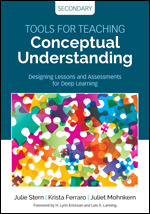

Tools for Teaching Conceptual Understanding, Secondary
Designing Lessons and Assessments for Deep Learning
Foreword by H. Lynn Erickson and Lois A. Lanning
Corwin Teaching Essentials
Students become experts and innovators through Concept-Based teaching
Innovators don’t invent without a deep understanding of how the world works. With this foundation, they apply conceptual understanding to solve new problems. We want our students to not only retain ideas, but relate them to other things they encounter, using each new situation to add nuance and sophistication to their thinking. To do this, they need conceptual understanding.
This book serves as a road map for Concept-Based teaching. Discover how to help students uncover conceptual relationships and transfer them to new situations. Specifically, teachers will learn:
- Strategies for introducing conceptual learning to students
- Four lesson frameworks to help students uncover conceptual relationships
- How to assess conceptual understanding, and
- How to differentiate concept-based instruction
Look no further. For deep learning and innovative thinking, this book is the place to start.
"The authors tear down the false dichotomies of traditional vs innovative education and provide a practical toolkit for developing creativity and applying knowledge through Concept-Based learning. Every practitioner needs this book to juxtapose what worked well in the 20th Century with what is essential in the 21st Century and beyond."
Michael McDowell, Superintendent
Ross School District, Ross, CA
"While most good educators recognise the incredible value of teaching conceptually, it is challenging. The authors have created accessible, practical baby steps for every teacher to use."
Dr. Vincent Chan, principal
Fairview International School, Kuala Lumpur, Malaysia
Free resources

Teaching Students to Learn Conceptually
Use the guidance in this section from Tools for Teaching Conceptual Understanding, Secondary, to begin a conversation with your students about how this type of learning might be different from what they are accustomed to doing.
Balancing Conceptual Thinking, Skills Practice, Memorization, and Review
This excerpt from Tools for Teaching Conceptual Understanding, Secondary, makes the case for conceptual learning and debunks the myth that simply covering the material will cause students to retain it.