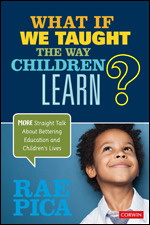

What If We Taught the Way Children Learn?
More Straight Talk About Bettering Education and Children's Lives
- Rae Pica - Education Consultant
Brain-Friendly Teaching & Learning | Early Childhood Education | Emotional Intelligence
Strengthen the connection between child development and learning
We often teach our children in ways contrary to what we know about their development. What if our learning environments honored children’s natural inclinations and used them to enrich their lives? To help students experience joy and discovery, while also preparing them for future schooling, we need to understand the connection between how they develop and how they learn. Pica brings decades of experience in education to advocate for this change.
Written as a follow-up to the bestselling What If Everybody Understood Child Development?, this book includes:
- 31 easy-to-read chapters on topics including disruptive behavior, creativity, self-regulation, screen time, and mental health
- Suggested next steps and resources in every chapter
- Real-life examples from the author's and others’ experiences
- Evidence from brain science research
- Easy-to-read format perfect for PLCs, book studies, and parents
The straight talk in this book inspires readers to generate change so that children can have the lives and education they deserve.
Free resources

Let’s Spark a Revolution in Early Childhood Education!
"Over the 40 years I’ve worked in early childhood education, I’ve believed many times that a revolution in the field was imminent. Heaven knows we’ve certainly needed one, as misguided policies have brought about increasingly inappropriate practices. Surely people who understand child development would finally begin making the decisions about ECE!
Clearly, I’ve been naïve..."
Read the full blog by Rae Pica, author of What If We Taught the Way Children Learn? and What If Everybody Understood Child Development?, regarding her experience in early childhood education and her thoughts on the response of schools to COVID-19.
"I've been impatiently awaiting Rae Pica's new book since I finished her last one! Few people understand children, parents, and educators the way she does. Rae is a passionate advocate, courageous champion, and creative teacher and mentor, with the ability to convey her wisdom both clearly and persuasively. What If We Taught the Way Children Learn? We would have a world in which children and adults collaborate to shape a better tomorrow. This book belongs on the shelf of anyone who cares about what it means to be truly educated."
"Rae Pica’s powerful, thought-provoking book provides rare and uncommon sense. This should be mandatory reading for all new teachers. Our kids would be MUCH better off if we practiced the way that this book suggests we do, and so would the educators around them.”
"There is a documented rise in challenging behaviors in classrooms and schools nationwide. We, as educators, are the 'front line.' We need to analyze our interactions with our students and work diligently to provide them with the most appropriate education possible. For our youngest learners, the importance of movement and play cannot be overlooked, minimized, or marginalized. This book helps to easily identify what is is occurring in classrooms today and provides meaningful, easy-to-implement ways to make necessary adjustments to address this crisis."
"Here is the bottom line: Beg, borrow, buy, or steal a copy of Rae Pica's book, What if We Taught the Way Children Learn?
Just one excerpt from Chapter 2: "We treat children as though they exist only from the neck up and only their brains matter, when research shows and good sense validates the importance of the mind-body connection. The failure to acknowledge this connection is the primary reason why play and movement are eliminated from early-childhood classrooms—and why young children are forced to sit for long periods" (p. 13).
Kids gotta move. Kids gotta talk. Adults gotta move. Adults gotta talk, and conversation for adults is more interesting, effective, and fluid if they learned to talk as kids!
Today's i'Geners have spent countless hours staring at screens rather than talking to teachers, classmates, parents, friends, neighbors...anyone. Rae points out that "social-emotional development is critical in early childhood and in-person interactions are necessary for social-emotional development" (p. 14). I have spent the last 19 years agreeing with Rae when she says, "Lack of physical activity is an overwhelming problem" (p. 45). Back in the dark ages, before color television or digital anything, we were outside more than we were inside. We played kick the can and tag. We chased each other around the neighborhood for no reason other than it felt to move, run, chase, pursue, escape, fall down, get back up, hide, be discovered, and laugh through all of it.
Exercise sends blood to the brain. Blood is sort of important, it turns out, as it carries oxygen and glucose with it. There are billions of neurons in the human brain, and exercise releases neurotransmitters like serotonin and dopamine that are critical to the whole thinking thing. I didn't know any of that as a new teacher. I had a textbook, an overhead, a voice, and some colored chalk. All the tools to bore my students into a comatose state. There are so many classrooms, schools, and districts that are moving away from teacher talk to student-to-student interaction, paired academic conversations, and teamwork.
What If We Taught the Way Children Learn should be in every teacher's hands and it should be part of every school's path forward.
"I highly recommend this book as required reading for every teacher and preservice teacher (and parents too!) The topics discussed in this book make you take a step back and think about current teaching practices and why we do them."
"Rae Pica’s simple yet powerful statement touched my heart: 'Children really aren’t complicated. All they want and need is you.' Anyone who has worked in an early childhood classroom over the past ten years can tell you that teaching today has become much more complicated, but it shouldn’t be that way and it doesn’t have to be. Rae has brilliantly designed each chapter of her book to clearly identify a specific challenge that is complicating the abilities of early educators to inspire and build on a young child’s natural love for learning. She gives her readers the why, what, and where: why the challenges in today’s classrooms are significantly more difficult; what can be done to make an immediate and positive difference inside the classroom; and where to find research-based resources that can be used to advocate for change in policies or false beliefs affecting today’s early childhood classrooms. What If We Taught the Way Children Learn will give early childhood teachers the confidence and support they need to have a voice regarding the issues that are complicating early learning in their classrooms. This is a must read and a brilliant resource for any early childhood educator who wants to make a genuine difference."